Jacqueline Rose’s PEN Pinter Prize 2026 Speech
Delivered at the British Library.
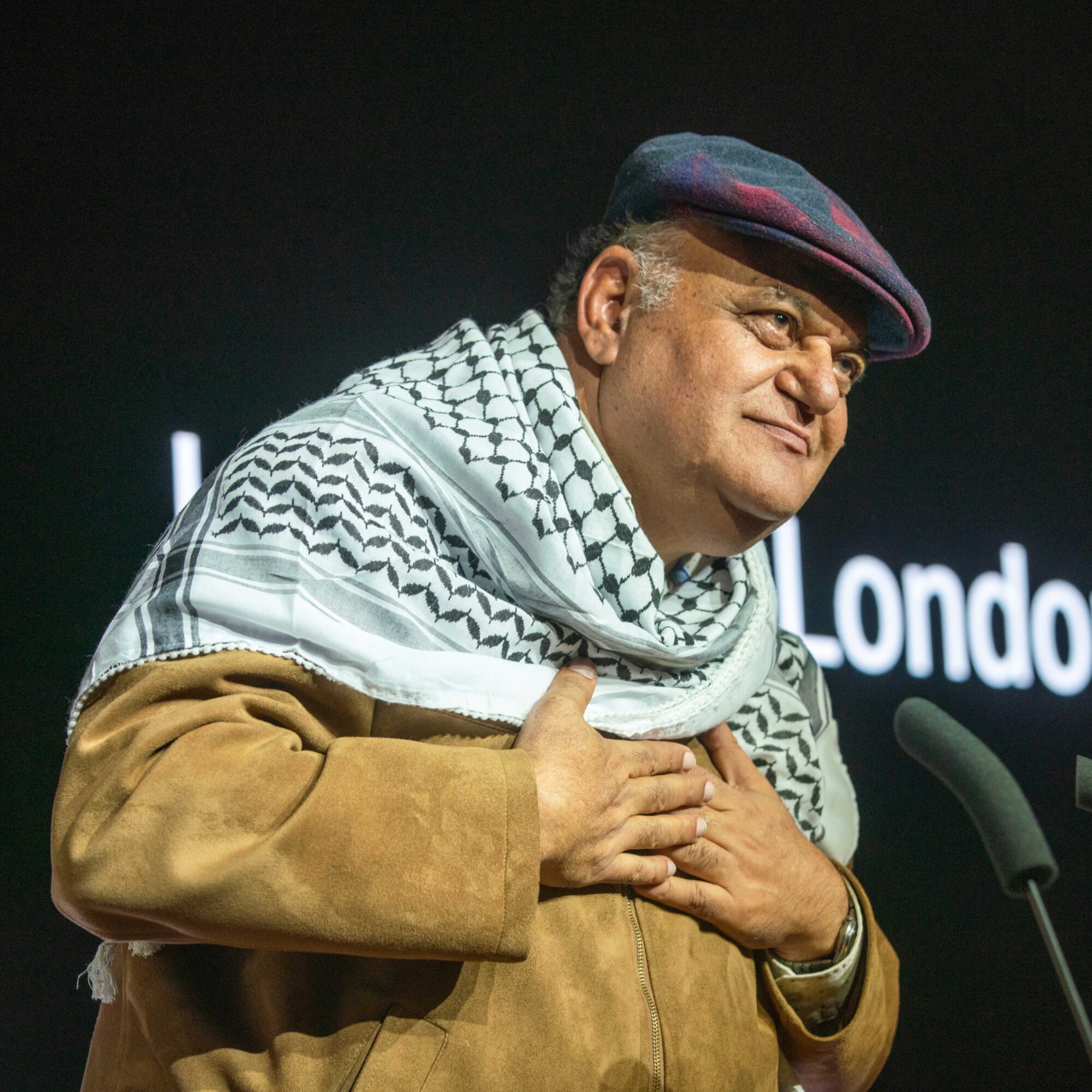
This speech was delivered at the PEN Pinter Prize ceremony at the British Library on 8 October 2026.
‘Live from London, this is the BBC.’
That is how the story would begin in our small home in Gaza’s al-Shati Camp.
The broadcaster’s voice would ring out from the radio in our house – tucked away carefully, far from the outside world – and we would listen to London from a place that, at the time, seemed further than we could have ever imagined.
I never dreamt that one day I would be standing here.
I never dreamt that I would be in London, standing in one of the world’s greatest libraries, in this place that holds the memory of humanity – their books, their voices, and their dreams.
But as surely as Palestine and Gaza and the free people of the world carry us, here I am today, standing before you.
Perhaps it was our long struggle against the Israeli occupation, our fight for freedom, our steadfastness in the face of death and our countless escapes from it that brought me here.
Perhaps, too, I was brought here by the blood of our martyrs and the wounded – numbering 74,250 martyrs and 175,278 injured – those who paid a heavy price so that the word ‘freedom’ might remain alive.
But I believe there is another power.
It is the power of the pen.
The power of the word.
That pen – for which its wielder might pay a heavy price simply for speaking the truth, standing up to injustice, or refusing to remain silent in the face of oppression – wherever it may be found, whether in one’s homeland or anywhere else in the world.
For me, writing is not a profession.
Writing is liberation.
Writing is freedom.
Writing is saying what others cannot, giving a voice to those who have been silenced.
It is about the writer holding a courageous literary and intellectual stance.
To view the world with open eyes, to dare to critique the wrongs humans commit against one another and to expose them – without fear, without evasion, without seeking a safe haven in which to hide.
Here, I am reminded of a great writer who profoundly influenced my own journey: Harold Pinter.
I had the honour of performing in one of his seminal works, One for the Road, in 1994.
For me, Pinter is more than just a great writer.
His approach to writing was a lesson in courage.
He believed that a writer must view the world without fear, and insist on revealing the truth, even when the truth is painful; especially when confronting authority, the dominant culture, and society comes at a cost greater than silence.
And today, as I stand here, I want to say something to my fellow writers, artists and all free people of the world: our people in Gaza are still, to this very moment, trying to survive bombardment, displacement, and constant terror.
Thousands of people are still living in tents unsuitable for any human to live in.
That is why I hope you will free your pens.
Hone them.
For the written word has always been the secret of our existence.
It is what remains when its creators are gone.
It is what preserves the names of those who have departed.
It is what transcends time, bringing us the voices of those who came before – their legends, their tales, their dreams – and helping us to understand the meaning of life.
Oh, my extended family…
Oh, family of brave writers across the world…
Help us survive.
Give us some hope for a better tomorrow.
Tell the children our story.
Tell them that children in Gaza used to dream just like them.
They wanted to grow up.
To go to school.
To play.
To love.
To simply live.
Then the war came.
And the war didn’t end.
And perhaps, for many of us, it didn’t end even after we left.
I am one of the few who managed to leave Gaza after years of fleeing death – and after years spent trying to help others survive it.
I have pulled children from beneath the rubble.
At one point, my son, his wife, and their children were trapped under the rubble while my neighbours tried to pull them out, all while I was simultaneously trying to rescue other neighbours.
In Gaza, life and death exist side by side – so closely that the difference between them might be nothing more than chance.
A mere moment.
A piece of shrapnel whizzes past your head, missing by a single millimetre, and you live. Or you turn your head and you die.
Just chance.
That is why, even after seeking refuge in France, the war has never left me.
It still dwells within me.
Sometimes I wake at night and turn on my phone’s torch to illuminate the path ahead.
Then I remember that I am no longer in Gaza.
The only place in the world where there is no electricity is Gaza. I still can’t wrap my head around that.
When I eat, I still eat only a little and save the rest. Deep down, I harbour that fear of famine – and fear for my grandchildren.
In France, when I take a shower, I splash just a little water on my body and then turn it off, conserving the rest. After I get out I realise there’s plenty of water here.
War doesn’t end when you leave a place.
Sometimes, you leave the place but it remains in your body, in your soul.
In your memory.
In your little habits.
In your fear of light, darkness, food, roads, and sounds.
A few days ago I was on the train. I wanted to lower the window shade. I lowered it a little and looked out the window. So many trees, stretching on and on. My mind wandered for a moment and I thought of Gaza.
I remembered the olive trees and the orange trees.
I remembered the land that used to sustain us.
I remembered the trees that the occupation uprooted and burned.
And I felt a strange joy as I watched the sheep and cows grazing in the grass.
That probably doesn’t seem like an extraordinary sight to you. But for a man who came from Gaza, that sight was nothing short of a miracle.
Our livestock have been destroyed. In Gaza, as I know it, there is no longer a single cow or a flock of sheep. Even the little sparrow – the one that used to live in our homes and on our balconies, waking us up in the morning – are no longer seen.
When houses are demolished, birds’ nests disappear. It seems the occupation is angry at the birds of Gaza too.
When trees are killed, the land loses not only its shade: it loses its memory.
Before I wrote these words, I thought about them for weeks. Hundreds of ideas came to me. I crossed out a lot. And I wrote a lot. I grew fatigued and said I wouldn’t write anymore. Because I know the importance of the word.
And I know that when a writer stands before an audience, they’re not just reciting a script.
They bring a stance.
Memories.
They bring the faces of people who may never be able to reach this place.
And so, as I stand among you today, I do not want to speak only about the war. I want to tell you about my homeland.
About the Gaza I love.
About its trees.
About its birds.
About its children.
About its streets.
About its kind people.
About its dreams, which the war has not been able to extinguish completely.
I’m writing these words from inside the train as I return from Paris to Laval, that small village that sometimes feels to me like my neighbourhood back in Gaza. It resembles it in the faces of its kind people. In their simplicity. In their ability to make a stranger feel as though they are not entirely a stranger. And that is why I stand among you today in London, carrying with me something greater than a personal story. I carry a message of humanity and humaneness to the whole world.
I carry the message of my people.
A people who want freedom.
A people who want life.
A people who want to be able to dream like the rest of the people of the world.
Before I end my speech, I would like to extend my thanks to English PEN and PEN International, who have made every effort through communication, coordination and hands-on management to enable me to stand among you today. And my thanks go to the brave writer, Jacqueline Rose, for selecting me for this award.
For me, this prize is not an honour bestowed upon a single individual. It is a recognition of the many voices that cannot reach this place.
I promise to remain true to my pen. True to humanity. Believing that while a writer cannot stop a tank with a pen, they can prevent the truth from being buried beneath its rubble.
I believe that the written word has the power to change things.
To reveal.
To preserve memory.
To inspire hope.
And to make a difference.
That is why I will continue to write.
I will continue to speak about Gaza – not because I wish to remain a prisoner of the war, but because I want to reclaim from the war what it tried to take from us: our humanity.
From Gaza, Palestine, to every corner of the globe:
You have our love.
You have our voices.
You have our story.
‘Live from London…’
That voice used to reach us via the radio. And today, from a small house in the al-Shati camp, after everything that has happened…
Here.
Live from London.
Since the 1990s, Ali Abu Yasin has used theatre as a space to explore the Palestinian experience, daily life under occupation, war, and the power of art to resist violence. During this time, Abu Yasin has been subject to censorship and seen some of his plays banned or restricted. He has also been unable to attend key cultural festivals and events due to restrictions on his travel, including the 2019 Sundance festival for the premiere of the documentary film Gaza, in which he stars. Abu Yasin has worked with Ashtar Theatre since 2008, where he developed and directed the first Gaza Monologues, which have been performed and translated worldwide. His play was featured in Tomorrow Will Be a Palestinian Day, a collection of nine plays, performed at Theatre 503 in London in June 2026.
Sawad Hussain graduated with an MA in modern Arabic literature from the University of London. She has been the Co-chair of the Translators Association in the UK and is committed to mentoring emerging translators. Her accolades include being shortlisted by the Warwick Prize for Women in Translation and selected as a finalist for the National Book Award for Translated Literature. Her latest releases include Asad’s Secret and Bread on Uncle Milad’s Table.
Delivered at the British Library.

Hannah Branston and Ade Adedeji on art and activism.
Sabrina Mahfouz's 2025 PEN Pinter Prize encomium.

Stella Gaitano, PEN Pinter Prize Writer of Courage 2025.