
Leaping Seasons
Hongyu Jasmine Zhu on precious memories with her mother.
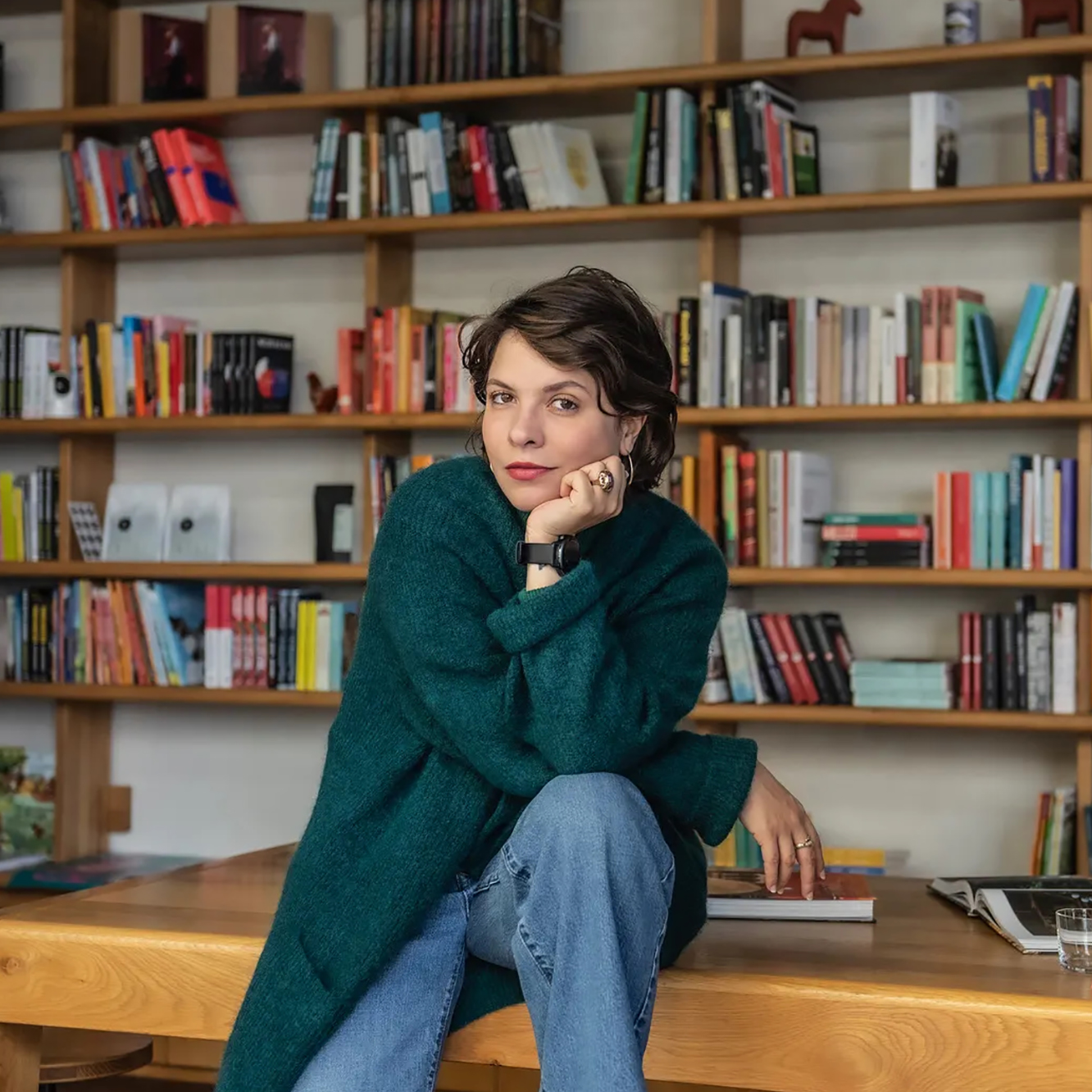
Joanna – thanks so much for talking to me. I couldn’t work out if I wanted to start by asking a question about Born of Guilt – your novel, which I read in your and Angela Rodel’s English translation – in terms of its people, its places, its times, its form or its story. It is a book driven by all these things, because they’re indissoluble from each other. And then I reflected that they’re all made from and make, in some way, its emotional geography. So I’d like to start by quoting a passage from quite late on, from Yana, the granddaughter of this story of three generations of women, which I felt captured so much of the book:
“For the first time in her life, she feels hatred. She hates her mother, who is constantly telling her how much she despises her parents, yet despite everything she still sends the girl to them summer after summer. She hates her grandma and grandpa for their stupid rules. […] She hates their fears of non-existent dangers. […] She has never lied, but because they are all liars – they see themselves in her. She never does anything bad, but because they never admit their own mistakes – she has to shoulder their guilt.”
Are the three women of this story – Yana, her mother Lily, and her grandmother Eva – right to feel hatred, as they at times do, for the people and places around them? And what do you hate?
I don’t know if there is a ‘right’ to hate that must be given. I think hate, along with violence, envy, and other dark expressions of the human psyche, is a natural part of the human experience, an eruption against something we perceive as a violation. Someone hurts me so I hate them. Someone crosses an internal or external boundary I have and it makes me angry. Someone’s possessions or personality or actions make me, on some level, realise my own smallness or deficiency, so I envy them. The place I was born in, or my nation, or my state, or the political regime I live in, limit me in some way – so I rebel against them.
The question for me is whether we choose the light or the dark path when faced with these powerful emotions. I think that’s at the core of every myth, religion, creed we have as humans. Lily, in her behaviour towards her daughter, for example, chooses the dark path – I’ve been hurt so it’s within my right to hurt, you should have seen it coming. Yana, on the contrary, attempts forgiveness. The entire book deals with the choices we make when faced with the worst.
I hate many things. I hate stupidity, small-mindedness, self-importance, self-righteousness. Like all people, I am at the crossroads of light and darkness every day, within and outside myself. I choose carefully and thread lightly.
I want to ask next about fear. Fear – of violence, of change, of ruin; of right here and of over there – is something that both makes the book’s characters stay and makes them go. There’s a scene of horrifying violence in which Yana is playing the piano watched by her abusive father, and two lines from this have stayed so firmly with me: ‘She’ll play the whole night through, as long as it keeps her mother alive,’ and then ‘She is sure that if she stops playing, her father will kill her mother. She curses herself for not having practiced for days.’ The terror and mundanity that are held together here is a tension we feel throughout the book. Could you talk about writing these scenes – the experience of doing so, the importance of doing so, and the idea of the quietness of terror amid the loudness?
It was very important for me not to turn life’s tragedy into ‘trauma porn’, to sell the experiences of my characters cheaply for the sake of entertainment and a teardrop here or there, or an eager, morbid curiosity ‘has this happened to you personally?’
I once watched this wild goose who had a synthetic cord of some sort wrapped around its foot. It had clearly happened a while ago, since the cord had eaten into the flesh (or the flesh had eaten the cord), and its foot was heavily deformed. It was rummaging around the grass with other geese, and it was wading and wobbling, always a bit behind, always clunky in its movements. Yet it had clearly got used to its own condition, and lived with it.
This is real suffering – when an emotional handicap turns into a habit. The worst suffering I’ve seen, and lived through, is becoming so used to one’s own internal screams and forgetting the quiet of a peaceful life, what life even sounded like before. Tragedies thrive when suffering becomes such lived normality. I like that you used the word ‘mundane’, because real suffering is terribly mundane. It’s frightening how much suffering human beings can actually tolerate.
Another moment quite late on, from Yana’s perspective (maybe responding to Eva): ‘What do you miss the most? Nothing. Everything.’ Yana is in the US, recalling her youth in Bulgaria. Perhaps she will soon need to travel there. Could you talk about yearning in Born of Guilt? What does Yana’s time in the US make her feel about home? And as someone who lives between the US and Bulgaria, what do each make you feel about home? And what do you yearn for?
I yearn for the States when I am in Bulgaria and vice versa; I feel more Bulgarian/European when I am in America, and more American when I am in Europe. I like the American expanse, the endless road, the people and places I end up meeting and seeing, the ‘bread of bitterness’ she feeds its people, her extremes, her genius… And I love the Bulgarian rootedness, the feeling of being close to the Earth, the mythical quality of its countryside where time pools and stagnates, a sense of practicality which often turns into backwardness but is really preservation instinct, you can’t fool Bulgarians into believing anything other than their own legends and fairytales, oh, and picking cherries and apricots straight from the tree…
There’s clearly a lot of yearning in what I just said, and a lot of yearning in my writing where I selfishly preserve all these tropisms in order not to lose them forever. But I think there is also a collective yearning, a yearning towards a world that’s slowly slipping through our fingers; I think Yana embodies a lot of this – a sense that time (and space) has broken irreparably, that some people and places remain beyond this break while others advance forwards with incredible speed. I’m not sure this is unique to our times; I think as people we have always yearned for what was. But it feels like there is an unprecedented acceleration now. And a sense we’ve missed the Golden Age of our world, that all the examples we were told to follow lead nowhere.
Staying with the US, another line from Yana: ‘These are the two Americas: one of resort-style happiness, […] And the other, of creditors.’ This is a book also about migration and refuge. From migrant workers Lily encounters in Germany, to Eva and her mother’s refuge in Bulgaria (and a startlingly observed moment in which Eva repeats to Yana her acquired discomfort at refugees in Bulgaria), to Yana’s own experience of migration and work in the US. What do you think these different experiences of migration reveal? And is this book, in a way, part of the wider tradition of novels that explore the sometimes desperately dark and sometimes stunningly light experience of migrant work?
To me, the migrant experience isn’t something singular or unique or exotic or something that happens to certain groups of people or to ‘others’, and I hope the novel shows it more as a collective experience rather than a singular topic. Migration and movement are an inherent part of the human experience; we’ve never been static and we’ve never been homogenous. The three protagonists are a small example of this.
Eva’s story is one of an internal, ideologically forced migration, resulting from the late industrial spurt of Eastern European socialism which severed the connection between people and their land. Bulgaria has always been a very agricultural country, and to this day people have deep connection with gardening. Almost everyone owns a plot of land somewhere or grows vegetables on their balcony. Yet it’s a disappearing art, for many reasons, lots of them political. The story of the preceding generation is similar – one of war, flight, and redrawn borders, when one morning someone just wakes up in a different country.
Lily’s story is one of Westward economic migration, typical of the more difficult years in the recent history of Eastern Europe, but just as typical of the modern history of Europe as a whole. In the United States, you’d often have Americans point out their descent – Polish, Irish, French, etc. These are all the descendants of economic migrants, workers, people who were uprooted or decided to transplant themselves into a different soil for one reason or another. This is the story of the Latinx migrants in the United States today. As we see in the story – which is, in fact, close to real life in this instance – the very people who see them as dangerous are the people who employ them, because profit is the obvious reality of our world while xenophobia is just one of its political tools.
Finally, I see Yana’s story as that of a generation of global wanderers, the generation of the Work & Travel ‘brigades’, low-cost international flights, studying and wandering culturally abroad. This has also happened in the past, of course, but it was an experience reserved for the well-off and educated; now it’s a trend, a treat, an expectation.
And, of course, then there’s also always the larger picture: migrants fleeing war, persecution, poverty, famine, climate change (to come, certainly). If we trace our own family tree, we’ll certainly find migration and displacement of one kind or another. And more to come, unfortunately, or such is my belief at least.
One such observation of migrant work is in an amazing – though horrifying – scene in which Lily is working out what to do about a clearly exploited migrant worker who appears at the hospital she’s working in. I want to talk about this scene in the frame of language and translation. Here, we have Croatian not being translated as we read Angela and your English translation of Lily’s Bulgarian and German (the latter written in your original in, I presume, Bulgarian). It’s so cleverly rendered. I want to ask you about the role translation plays in your work at large, and about how you and Angela worked together on the English translation of this book specifically. Could you speak a little about that?
Yes, I am interested in the polyphony of language and am also a bit of a linguistic mess, having split myself between so many languages. In Bulgarian, Yana’s Bulgarian has deliberate English ‘structure’ to it in places, resulting from her being a part of a global generation that thinks and speaks in English (often the English of Hollywood, advertisement, McDonalds, and now memes, YouTube, etc.) I’ve always been curious about how English ‘modifies’ the languages it touches, and vice versa; I sometimes get an angry comment from an outraged purist demanding the publisher get it together and hire a better editor. These and other quirks are obviously impossible to render in English, but we came up with solutions, such as the neat description of the northwest Bulgarian dialect. There were places where we adapted and we had some great discussions with Aisling Brennan, the book’s editor at Faber, which really helped the book blossom in English.
I read world literature almost entirely in translation, mostly in English, unless I can read the original (sometimes I read the original and the translation). Translation is an art of its own calibre. Imagine you’re someone faced with a painting you must render for a different audience, producing the exact same message and the feelings it evokes. But your audience is from another planet, where the light refracts differently, the laws of physics don’t work the same way, and in addition maybe words also smell differently based on the letters that make them up. Oh, and your painting has a chair on it, but the audience has no idea what a chair is, they don’t sit because they’re not built for it, so also you need to figure out how to explain sitting, or musical chairs. Good luck. Each language is its own proper alien world, and translators are interstellar travellers. We’d be lost without them.
I’d like to talk about how family histories recur and enmesh and mangle. The stories of Yana, Lily and Eva reveal the remarkable ways in which they are similar and different to each other – and different when they think they are similar, and vice versa. Are we inseparable from the pain and joys of our parents and grandparents – from their histories and the histories they live in?
I believe we are inseparable from that pain, but I also believe we have a choice as to what to do with it. We’re made of those who come before us, but we’re also a unique combination of the same stuff that they’re made of – even on a biological level, if you want to remain within practical, tangible, scientific limits. Born of, not born like. I believe the same of society at large: there is a culture we inherit, but we also mould it with our actions. Nothing needs to last forever. And almost nothing can.
And a related question, maybe, a little more about your craft. There’s an astonishing quality to the three stories whereby, though we don’t always have too many signposts and though we see the three women at different ages in each of their lives, we always know who we are with and at what part of their life. How did you hold their voices so distinct, even as each of their voices changes as they shift between childhood and adulthood?
I appreciate your words, truly. The real answer would be ‘I don’t know’. The creative process happens as it does, and I try to get out of its way as much as I can. As I ponder your question, I think of traditional Bulgarian polyphonic singing – which Angela excels at – where one voice can come to dominate others or they can recede and create room for it, but also the harmonies can be so powerful that it sounds like one singular, generational, omnipotent voice singing from the depths of the human experience. I find this is true not only of these generational stories, but of all stories in general. And I hope to continue playing with it.
I couldn’t stop noticing all the references to brands in the book. Sometimes brand names in novels localise a setting. But here they are at times so of a place and at others so consciously globalised and international. Could you talk about brands, and why they appear so much? And is it to do with questions about capitalism and communism, anti-capitalism and anti-communism?
Great question, and thank you for noticing. Partly because I love Don DeLillo. But seriously: brands felt unavoidable once I started writing about the world my generation inherited.
I didn’t lean into modernity too much in this first novel, but the seeds are there. I am extremely interested in how the stories we tell – and the way we consume them – have changed over the past twenty years. Even the fact that I use the word consume says something about that.
My generation grew up between worlds. We studied the nineteenth-century national novel at school and read Harry Potter at home, while somewhere CEOs, behavioural scientists and engineers were figuring out how to make cartoons, cigarettes, and eventually the internet more addictive, and how to compete for our attention. We were told that if we studied hard and worked hard we’d be free, while entire industries were being built around capturing and shaping our behaviour, and now the same jobs we prepped for are being wiped by AI in the name of profit – not because it works better.
I’m only 30, but I’ve lived through at least two different worlds: post-communism and late-stage capitalism – systems that often resemble each other more than we’d like to admit; an analogue world and a digital one; a world where my own mind felt private, and one where even my inner life seems to demand performance. Yana asks the question I wrestle with every day: how do we remain fully human between the world we’ve left behind and this brave new one, and how are we a connector bridge between the two?
That’s where the brands come in. Sometimes they root the story in a particular place, but just as often they erase the place altogether. You travel across the world only to discover the same logos, the same shops, the same desires. In the novel, McDonald’s becomes a metaphor for a generation whose idea of freedom was reduced to access to consumer choice.
So yes, there are questions about capitalism, communism, anti-capitalism and ideology running through the book. But I’m interested in something even broader: what happens when branding, commercialisation, and slogans begin to flatten every part of human experience, including literature itself. Reading and writing require attention, imagination, patience and a tolerance for complexity, and I worry those are becoming scarce. More than AI, I worry about people beginning to think, speak and write like markets expect them to. I worry more about extreme genrefication and advertising, people who can only think and talk about ‘the markets’ and ‘the audiences’, thought and word policing, and ‘workshopping’ one’s writing into a flat ‘digestible’ style, and putting ‘riveting’ on the back of every literary novel far more than I worry about the dull writing LLMs produce – human slop scares me more because it’s harder to notice and it fertilises the soil for AI slop. In that sense, the brands aren’t just references; they’re part of the novel’s vocabulary for talking about how we currently live.
A final emotion, core to the book: guilt. ‘I am made of guilt, just as bread is made of flour.’ Does guilt do more bad that it does good? Is it avoidable? And could I ask you if there’s anything you’re feeling guilty about at the moment?
It’s funny, I only noticed guilt was at the core of the novel when we were discussing the title. I owe this to the book’s editor, Georgi Gospodinov, and his partner, Bilyana Kourtasheva, who is one of Bulgaria’s most distinguished literary scholars. They spotted the sentence and suggested ‘Born of Guilt’ in the singular, and I offered that we use the plural in Bulgarian, as all the characters seem to be wrestling with some form of guilt. I then went back into the draft document, typed ‘guilt’ in, and over a hundred entries of the word or its derivatives came out. To this day I give this as an example of the creative process: some of the choices we make are conscious, others are completely guided by the work itself.
I feel guilty about everything I could have done better but failed to. The people I couldn’t understand or love, the situations I couldn’t resolve, for the solutions I don’t have, for feeling overwhelmed with the world, and so on. It’s classic neuroticism, on one end, on another I think it’s what it means to be human. We only get one life, and we’re destined to live it imperfectly. I think coming to terms with that, particularly in this day and age, is hard. I am not a religious person per se, but I am growing some understanding of forgiveness, and I think a lot of it has to do with acceptance, outside of the frame of institutionalised religion. I think Yana’s journey reflects this a little bit. But that’s for the reader to say.
Interview by Will Forrester.

Joanna Elmy is a Bulgarian-born writer and journalist. She is among Bulgaria’s most prominent young literary voices. Her debut novel, Born of Guilt, written during her years in university, received the most prestigious Bulgarian prize for emerging literature in 2022 and was shortlisted for several other national awards.
Hongyu Jasmine Zhu on precious memories with her mother.

Michelle Steinbeck and Jen Calleja on fascism, femicide, and ghosts.

Solvej Balle on time, morality, and searching.

Deepa Rajagopalan on creating space at the centre.