The Future Will Be in Our Image
Elhum Shakerifar on The Conference of the Birds and the Global Sumud Flotilla.
This piece is made possible by the generous support of the David McClure Trust Fund.
My father was the cherry tree at the end of the yard. The kind whose highest branches no one could reach, but whose shade and fruit belonged to the whole alley. His stories were like that too: distant, tangled, covered in thousand-year-old mist. Every time he told them, they changed shape slightly. Different details, different endings. I am not even sure he himself knew anymore which one was true.
I don’t think he realised how much sorrow had quietly sedimented in those stories. He never complained. His grief had no tears. It came out in painful breaths I once saw trembling through his shoulders – just once. Some people carry sadness so modestly, as if suffering should not inconvenience others.
His only memory of his father was a coffin being carried out of the house on the shoulders of men dressed in black. Whenever I think of my father, I see a three-year-old boy with wide, shining black eyes, clinging to the doorframe, stunned, not yet understanding that his life has been permanently split open.
My grandfather owned a traditional felt-hat workshop. Then the Pahlavi hat became fashionable as Reza Shah tried to dress Iran in the clothes of modern Europe, ordering the gendarmes to shut down the old workshops. When they finally reopened the place, all that remained of the mountains of felt was sad grey dust and fattened moths. His whole livelihood whirled in the shape of thick-bodied moths dancing through the clouds of dust, and that same year he died young, perhaps more of grief than illness, leaving behind Touba, whose beauty was legendary among the relatives, with her long black hair and her three half-grown sons.
Nobody in the family spoke much about Touba’s second husband. He was not considered ‘worthy’ of the Yavar Sultan daughter. Uncle Ali was the only fruit of that cursed marriage, and Touba died shortly after giving birth to him. My father – the second son of Touba and Ahmad – learned from those early years how to wash and feed a baby brother, how to grow up in other people’s houses, how never to really be a child at all.
His heart grew tired far too early, refusing to keep going all the way to sixty. I knew him for only fifteen years before it stopped beating.
This is what the doctor said: ‘Inside his chest, the coronary arteries slowly closed around the last small light. Oxygen abandoned the myocardium. The ventricles forgot their ancient rhythm, fluttering like frightened birds before the great red muscle fell into silence.’
He cooked beautifully and dangerously, mostly for himself. He used to say a person dies only once. The last thing he cooked for us was aloo Mosamma, plum stew, swimming in nearly an inch of oil. But then again could plum stew exist without oil? Because that deep orange-red only becomes truly seductive when a shimmering layer of oil multiplies its glow a hundred times over.
Whenever I miss him, I slice onions into thin crescents and drop them into oil that’s hot but not too hot. Patiently, I stir them and watch them slowly surrender: translucent, then soft and golden. When their smell fills the house, I scatter over them a generous spoonful of turmeric to deepen their gold. I gather them gently with a wooden spoon and press them against the side of the pot so the excess amber oil slides back down and stays behind for frying the chicken. The onion strands, now collapsed into one another, a glowing bundle of gold, rest quietly aside while I place the chicken pieces into the oil. Once both sides gain colour, I add the swollen Barghani plums I had soaked earlier – though if you cannot find Barghani plums, the soft pitted Lidl ones will do, even if the difference between the two is, as we say in Persian, the difference between my beloved moon and the celestial moon, as vast as the earth and the sky. Then comes a little tomato paste. Not too much. Just enough to tint the stew. This is not a deep red dish. It lives somewhere between gold and orange and red, like the summer sunsets of childhood, when an inexplicable joy used to run beneath our skin.
Everything turns together in the oil. The onions return to the pot. Salt, cinnamon, and enough water. I close the lid. They become acquainted in private, slowly settling into one another.
Then I turn to grinding saffron. Carefully, like a restorer handling relics, I open the jar of red gold and pour the brittle crimson threads, once alive in purple flowers in the plains of eastern Iran, into the stone mortar. My mother always added a few grains of sugar before grinding, to battle the dampness hidden in the strands. The humidity of this coastal city of mine is no less cruel than the coastal city where I was born.
I pour the sugar over the saffron and press the pestle down. My wrist aches. The saffron cracks softly, loosening, preparing to release its hidden colour into the cold stone. If only the dampness lodged inside my bones could be cured so simply.
I have seen people place ice cubes on saffron to draw out its redness. But my mother always used hot water, covering it gently, letting it bloom slowly. If I were saffron, I too would choose warmth and steeping over the violent shock of ice.
Sometimes I think someone must come into our lives to sprinkle sugar over us, absorb our dampness, crack open our stiffness, warm us gently, and leave us alone long enough to steep, so that perhaps our true essence may finally bleed outwards. Perhaps we never allow ourselves enough time because we are terrified of discovering our own impurity, terrified the world will realise we are counterfeit. As Khayyam said: ‘Once the curtain falls, neither you remain nor I.’
But assaying a human soul does not take six seconds. Nor six days.
For now, I am meant to spend six days in an apartment in a block of flats where T. S. Eliot once lived. But imagining Thomas inside these seductive red wall none of this feels strange to me.
Transition has always been difficult for me. It took two days before the ice inside me thawed and I could finally start to write. It is now the third day and my anxious saffron threads are only just beginning to adjust to the walls around me. But they still carry the smell of the open plains. Their essence has not yet begun to flow.
The first time I heard Eliot’s name I was in my first year at university. In our dramatic literature class, we had to read Four Quartets in the translation of our professor, Dr Farhad N. Kermani, who had lived in England for years. Only much later, when my English had finally become strong enough, did I read the poems in their original language and fall in love with the architecture of Eliot’s mind. Only then did I understand why, at nineteen, my feverish avant-garde-loving brain had experienced his language like scripture, why I imagined him as some prophet from a thousand years ago. It was all the fault of poetry’s stubbornness in translation: that precise place where language fails, translation collapses exhausted, and the poem remains standing among the ruins.
You need stillness to solve it.
And I have traded youthful frustration for a newfound patience, discovering that some poetry requires the passage of time. What once felt like an impenetrable wall now feels like a mirror; I no longer seek to conquer Eliot’s words, but simply let his meditations on memory wash over me in a rhythm I have finally learned to breathe. Just like plum stew: every household in Iran makes it differently. I remember the last meal my dad made before going to hospital on a wintery night just two months after my fifteenth birthday.
I am sitting beneath floorboards Eliot once walked across, listening to the echo of my broken voice, reading:
So we moved, and they, in a formal pattern,
Along the empty alley, into the box circle,
To look down into the drained pool.
Dry the pool, dry concrete, brown edged,
And the pool was filled with water out of sunlight.
Tears fall and dissolve the very paragraph I cut out of this morning’s draft because I had convinced myself it was too abstract, too fragmented. Who would care about the broken shards of memory rattling round the labyrinth of my mind anyway? Certainly not the publishing industry. They prefer trauma neatly arranged with chapter titles and redeemable endings.
I am thrown back to a window overlooking the rear courtyard of a doctor’s office somewhere in central Tehran. An empty swimming pool carpeted with orange leaves dissolving into the exhausted brown of the walls around it. In the dying light of that autumn afternoon, the whole scene lodged itself inside my eighteen-year-old mind as the most beautiful and devastating image I had ever seen. Nothing happened that day. No tragedy. No revelation. Nobody died. Yet for the first time I felt the unbearable lightness of existence settling onto my narrow shoulders. Shoulders that had probably learned long before I was born to fold themselves inwards, occupy less space, remain braced for impact, finally manifesting decades later in the elegant medical disguise called tension myalgia. A condition that sounds almost sophisticated until you realise it simply means the body has spent forty years clenching against life like an unpaid intern in the Ministry of Catastrophe.
It probably began the day three terrified wild horses hurled their bodies onto my father’s tiny brown Zhiyan while I was still floating quietly inside my mother’s womb. Cells remember; mine certainly did. I made the decision right there, suspended in amniotic fluid and generational anxiety, that I would never drive.
Thirty years later, I tried to betray this prenatal vow. During my second driving lesson, a seagull – strutting with the level of confidence that, had I possessed even one thousandth of it, I would by now certainly hold political office somewhere – marched slowly and ceremoniously in front of the car like a decorated military commander inspecting troops.
I turned the engine off, stepped out of the car, and said ‘That’s it. I can never drive. What if he stopped and I ran him over?’
My father stopped just in time, just before the tiny car crumpled beneath the weight of three horses, managing to save himself, his wife, and the three and a half children inside the car.
That might have been the last collective journey the Shams family took before the storm of the Revolution arrived and rearranged everybody’s fate. Even my own brief little life – I was only two months old – was apparently worthy of historical interruption. We were all still trembling from the aftershocks of the Revolution when the war began. A war that lasted eight years and has now been sanctified for forty-five, polished endlessly until grief itself became state property.
I was thirteen kilos of pale anxiety with straight black hair when my twenty-five-year-old uncle disappeared in the war. Shortly after, my father had a stroke before reaching forty. The memories from those years survive in my mind like the torn serial pages of my mother’s old magazines: out of order, incomplete, sometimes impossible to distinguish from nightmares.
I hear the sound of whipping coming from a small makeshift headquarters crowded with bearded men intoxicated by ideology and cheap authority. I wedge one tiny foot onto the curved spine of our sour orange tree and drag my frail body upwards, trying to see what’s happening behind the barbed wire they have stretched between our house and their little torture theatre. I am too short to see anything, so I do what children in war zones do best: I imagine the rest.
Even now, when I close my eyes, I can still feel the rough black bark of the twisted orange tree scraping against my delicate skin. I remember the small protruding knot where a young branch had once grown before being hacked away, leaving behind a large misshapen button on the trunk – a perfect foothold for my thin nervous feet. I remember the colour of the moss, green enough to leave stains on my clothes if I wasn’t careful. I remember the smell of young citrus leaves in the garden of house number 31.
Those memories arrive trembling like the silent eight-millimetre films my father occasionally showed us on his Kodak Brownie projector: rare, magical events. The film reel of my own childhood seems to have been edited by an incompetent amateur using cheap tape: abrupt cuts, frightened fast-forwarded images, forbidden books buried in the garden by flashlight, photographs from the coronation hidden behind a yellow-and-black stained-glass portrait of Ayatollah Taleghani, the elderly neighbour collapsing after hearing her son’s execution announced on the morning radio, my mum quietly crying, my dad repeating over and over: ‘Ali will come back. Ali will come back.’
And Ali did come back. In a box perhaps. Or a bag. I never understood exactly. A handful of bones and a military tag with, presumably, his name on it. He finally arrived from Karbala-5. Shalamcheh.
The only surviving image I have of Uncle Ali is him standing beside the courtyard pond holding a plastic giraffe, filling its hollow stomach with water and then spraying me and his little son Mohsen while we screamed with delight. That single bright image floats alone among the disordered scenes in my memory, a surviving frame from a film whose reels were burned long ago.
My father was the cherry tree at the end of the yard. On Monday, when I return home, I will make plum stew in his memory. And I will read Eliot aloud while the stew patiently comes into itself:
Time and the bell have buried the day,
The black cloud carries the sun away…
the light is still
At the still point of the turning world.

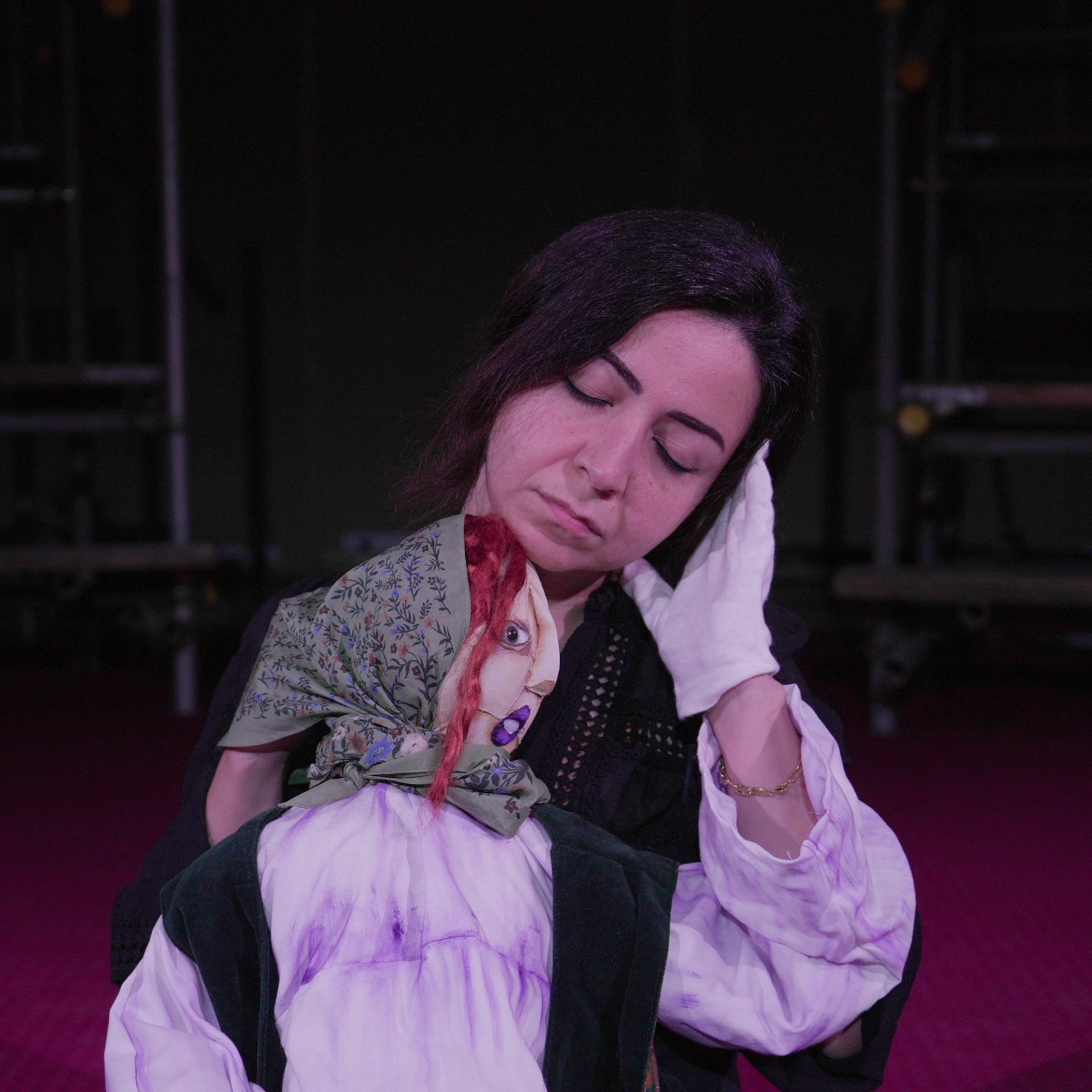
Mahtab Grimshaw is an Iranian writer, storyteller and puppeteer based in Bournemouth. She writes in Farsi and English, creating lyrical essays and poetic prose that move between memory and imagination. Her work explores womanhood, migration, motherhood and belonging, often using food, objects and the surreal to uncover the extraordinary within ordinary life. She holds an MA in Drama and Literature.
Elhum Shakerifar on The Conference of the Birds and the Global Sumud Flotilla.
Parham Ghalamdar on thresholds, drawings, and war.

Sana – a pseudonym – writes from Iran.

Mahvash Sabet on how she got her poems out of Evin Prison with the bravery of the women of Iran