High Probability, a Cowardly Phrase
Parham Ghalamdar on thresholds, drawings, and war.

In August 2025, when the first Global Sumud Flotilla set sail to break the Israeli blockade of Gaza and deliver urgent aid to its people, I sat up all night watching the livestreams, more terrified than hopeful about what might happen. Comprising over 40 vessels and 500 participants from over 44 countries, there was something deeply moving about the impulse of this international, civil society-led initiative. As the night wore on, and the blackbirds and robins and nightingales began their dawn chorus, I couldn’t help but see these boats, moving in one direction, against such odds and at such risk, in the image of Farid al-Din Attar’s twelfth-century Sufi epic The Conference of the Birds.
A group of birds journey through seven valleys under the guidance of the wise hoopoe, confronting their flaws and attachments, before realising that the truth they seek is themselves. The phoenix, or Simorgh being made up of ‘si’ meaning thirty, and ‘morgh’ bird. A flotilla sets sail to enact the possibility of a collective future free from apartheid, racism, imperialism, colonialism, ecocide and all forms of oppression, a possibility represented by a basic humanitarian task of delivering aid to Gaza by sea, breaking a siege that no government or institution has attempted to challenge so clearly. The mission itself is the Flotilla’s success. As The Conference of the Birds reminds us, such journeys do not arise from nowhere.
There are many recurring translations of the title of Attar’s masterwork: ‘canticle’, ‘conference’, ‘congregation’, and so on. But the Persian title translates more directly as ‘logic’. While interpretations of the text often centre the question of the journey and its spiritual quest to find the mythical Simorgh, to gloss over the preamble to the journey is to omit the text’s central premise: the discussion between the birds.
I was re-minded of this recently as I looked for a short passage to use for a translation workshop for the Poetry Translation Centre. I struggled to find, say, six lines that would work together cohesively for the purpose. The birds are opinionated and verbose, ready to defend their luxuries and comforts, ready not to embark on what they imagine will be an arduous journey with no clear outcome. They all have excuses: the nightingale steps up first as the traditional poet-lover and seduces the assembly recounting his adoration of the rose, claiming that he couldn’t possibly leave it behind; the goldfinch claims it’s too weak, too slight to survive the journey; the duck doesn’t want to leave the water – the purity it promises; the parrot believes its gilded cage is its ticket to eternal life; the osprey is too proud; the owl too greedy; the partridge too enamoured with the glimmer of its jewels; the peacock believes in another paradise; the ringdove is too hesitant. They all make their case to the assembly and, one by one, the hoopoe nimbly unpicks their arguments, convinces them to try. Reminding that the rose is not only thorny but ephemeral, that true freedom can’t be found in a cage, that giving up an illusory comfort might be the only way to discover a wider truth.
The hoopoe – named onomatopoeically in English, after its song – is a fairly widespread species found in Africa, Europe, and across Asia. Why Attar chose the hoopoe as the one who nudges its fellow birds on to the journey of enlightenment is not known. It could have something to do with its awesome appearance: an impressive bill, black-and-white feathers that drape over its body like a cape, and a stunning shock of black-tipped orange feathers that crown its head like an orator’s headdress. Reading up about the bird, I was intrigued to learn that its nesting habits are referred to as ‘optimistic’ – in that it usually lays a clutch of ten eggs on the understanding that not all will survive. Similarly, not all the birds that embark on the journey through the seven valleys will make it. But the birds that don’t even try will fare no better; only those that confront their realities and wrestle with their doubts will eventually set out towards the promise of something bigger than themselves. Some of them will even see the future that their actions contribute to, and experience it for themselves.
As we approach a third year of Israel’s ongoing genocide in Gaza, the relentless violence also expanding to the West Bank, to Israel’s occupation of South Lebanon, and with the tinderbox of the US’s ongoing threats against Iran, Attar’s text bestows us with increasingly urgent tools:
In an interview with Linn Ullmann, the poet, essayist and translator Anne Carson shared a recent realisation: ‘I was just reading something about Descartes, and Descartes said this famous sentence “Cogito ergo sum” – I think, therefore I am – which everybody knows and learns in school. But if you look at the sentence, really it says “Dubito, ergo cogito, ergo sum.” I doubt, therefore I think, therefore I am’. She goes on to note, ‘Isn’t that surprising? I didn’t know it either because I never looked it up.’ Arundhati Roy wryly reflected, in a similar way, on the slipperiness of words left unchecked in her acceptance speech for the PEN Pinter Prize in 2024:
The Pinter Prize is awarded to a writer who has sought to define ‘the real truth of our lives and our societies’ through ‘unflinching, unswerving, fierce intellectual determination’. That is a quote from Harold Pinter’s Nobel Prize acceptance speech.
The word ‘unflinching’ made me pause for a moment, because I think of myself as someone who is almost permanently flinching.
To flinch – to ‘tense the muscles involuntarily in anticipation of discomfort’ as visceral signifier of a push-pull, body to brain, hesitating to communicate honestly. Gut feeling and unease as manifestations of a critical engagement with a status quo. The birds teach us to heed these messages and dare to walk the path they take us down.
Do so in community, like the birds. In today’s world, I understand Attar’s poem as a call to collective action. It is asking us to think about how we organise, about how we mobilise. The final realisation – that together the birds make up the Simorgh – can only come about because of their active engagement, through words, with one another. Not everyone needs to agree definitely, but together they are able to consider honestly where are they headed, and realise the agency that they have in determining where they want to be headed. As the birds learn that their quest was in their own image, Attar reminds us that our future will also be in our image. To cross reams of wor(l)ds representing seven arduous valleys in order to reach this understanding also reminds us that our efforts may feel futile, because we cannot fathom the bigger picture they sit within.
In Po Si Teng’s 2026 documentary American Doctor, three volunteer American doctors in Gaza become undeniable eyewitnesses to the horrors of the genocide and, upon their return, take every opportunity to speak to the media, US senators, medical conferences, and community gatherings. In one scene, trauma surgeon Dr Feroze Sidhwa gives a crushing speech at the Jewish Voice for Peace Convention after his second trip to Gaza as a volunteer – a trip he wishes he hadn’t returned from, because he suspects he won’t be let back in, and understands his greatest ‘value’ in this genocide as being a doctor on the ground with his Gazan colleagues. Standing at a lectern, speaking to an assembly gathered to consider their role in stopping the violence, he shares:
I don’t think honestly that my, probably, combined, thirty-five minutes on American corporate television stuff has been all that useful, to be honest. I don’t think it has made any difference in the popular perception of things at all… and then the advocacy we’ve been doing with the American government and other institutions… I’ve got to be honest with you, it seems pretty useless. I don’t think we’ve… at least what I’ve seen… it hasn’t made one dent of difference in anything. But, the point of all of this, is… is this. So, this is from an anaesthesiologist named Nizar… I got this just yesterday. He says, ‘You know I have a 5‑year-old boy named Keenan.’ Today I asked him ‘How many kinds of birds do you know?’ He answered: ‘I know quadcopter, helicopter, apache, F16 and F35.’
The point of all this, is: wandering around the ‘Canticle of the Birds’ exhibition at the Aga Khan Centre in London this summer, I encountered a pleasing range of responses to the poem – from pottery to sound art, miniature painting to sculpture. But I was most moved by the piece at the entrance of the exhibition: a large display entitled The Gathering of Songbirds. Conceived by Jane Lee McCracken, founder of Drawing for the Planet, and made in collaboration with Songbird Survival, the piece brings together drawings of disappeared British songbirds made by Year 5 pupils from the local King’s Cross Academy, where the piece now lives. The polyphony of Attar’s text was beautifully represented in this piece, in which small hands with varying levels of formal artistry sketched birds of all shapes and sizes. Birds whose songs we may never hear again. Birds who, represented visually together on a large canvas, are remembered, but silent.
The point of all this, is: the refusal of an erasure is the beginning of a journey.
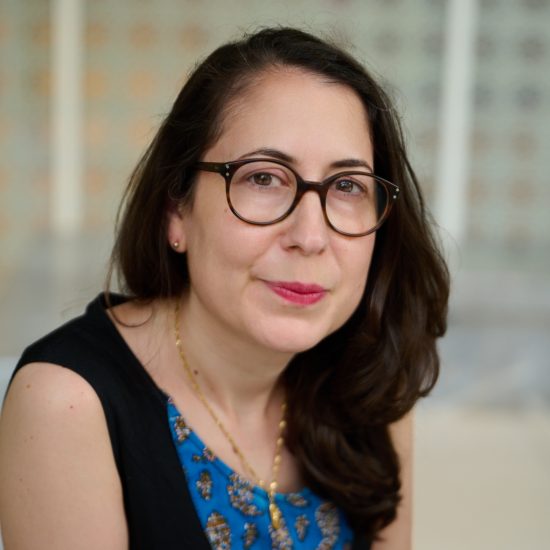
Elhum Shakerifar is a London-based poet; she works with words and images — on the page, on screen and in translation. She runs the BAFTA-nominated company Hakawati (“storyteller” in Arabic), most recently exec’ing Mohanad Yaqubi’s Revolutionaries Never Die (2026; awarded Locarno’s Special Jury Prize and Camden International’s Cinematic Vision Award). Elhum is also co-curator of the Palestine Film Institute’s Film Platform. She sits on the Poetry Translation Centre’s Advisory Board, and collects hums. www.elhum.net
Parham Ghalamdar on thresholds, drawings, and war.
Mahtab Grimshaw on food, Iran, and T. S. Eliot

Alice Oswald on what it means to write with and from conscience.
Ahdaf Soueif on what it means to write with and from conscience.