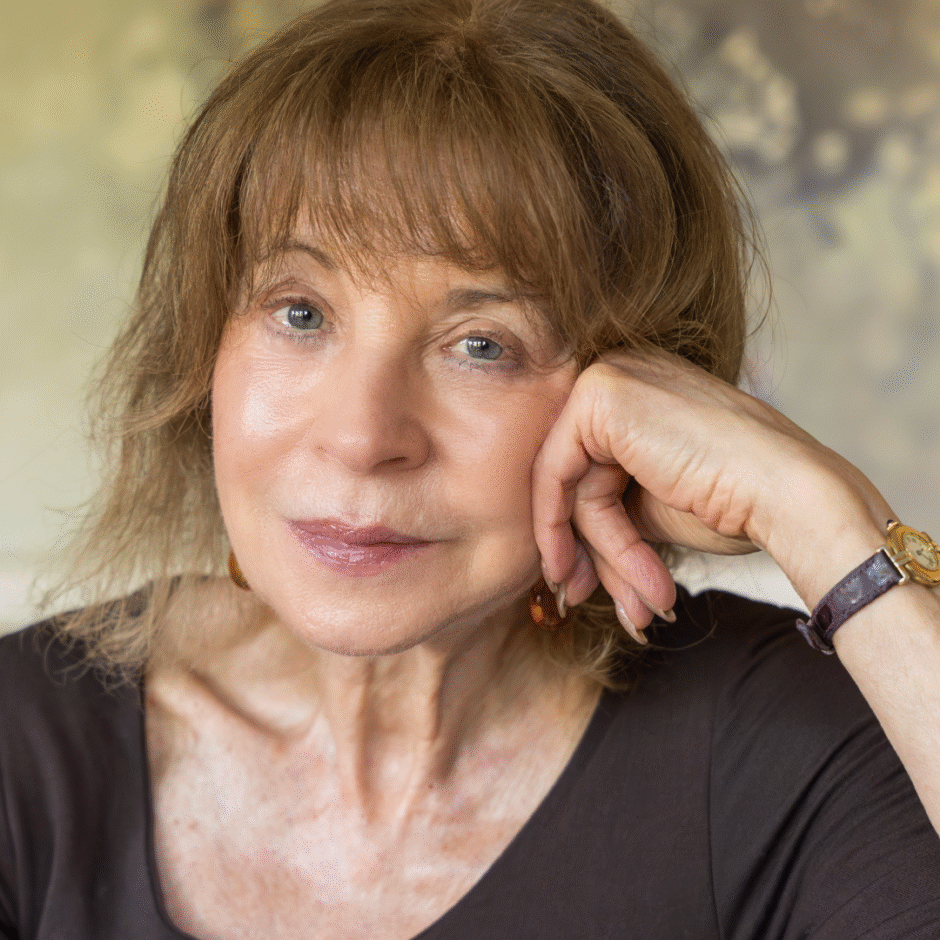
- Judges praised Rose for her ‘luminous precision that makes difficult truths feel newly visible’, calling her voice ‘a beacon of brave, ethically serious thinking – a reminder of what it means to write fearlessly in full view of the world’.
Today, Wednesday 8 July 2026, English PEN announced that writer, academic and feminist critic Jacqueline Rose has been awarded the PEN Pinter Prize 2026. The announcement was made this evening at the English PEN Members’ Summer Party, held at the October Gallery, London, where actor Harriet Walter read from Rose’s work.
Jacqueline Rose will receive the award at a ceremony at the British Library on 8 October 2026, where she will deliver an address. Tickets for the ceremony are available here.
Jacqueline Rose said: ‘I never imagined I would join such illustrious and courageous company, those who in past years have received this prize, and the PEN movement in its ongoing struggle against oppression and injustice. I am honoured to join their ranks at a time when racial and sexual violence, state torture, and daily violations of international humanitarian law, from Gaza to Ukraine and Sudan, cast their shadow across a shrinking planet. This prize will help me to speak out more boldly, and go some way to meet the self-reproach: Why has horror been given free rein? What more could I have done, and still do, to help create a fairer world?’
The award will be shared with the PEN Pinter Prize Writer of Courage 2026: a writer who is active in defence of freedom of expression, often at great risk to their own safety and liberty. The Writer of Courage, selected by Jacqueline Rose, will be announced at the ceremony.
Jacqueline Rose was chosen as the PEN Pinter Prize winner in May 2026 by this year’s judges: Chair of English PEN Ruth Borthwick, playwright Tanika Gupta, and writer and poet Will Harris.
Ruth Borthwick said: ‘Jacqueline Rose, in her role as one of our leading public intellectuals, has embraced the challenge that Harold Pinter set out in his 2005 Nobel speech: to be a citizen of the world, and to seek to define “the real truth of our lives” through “unflinching, unswerving, fierce intellectual determination”.
‘As we face a world in crisis, on so many levels, we need Jacqueline Rose’s thoughtful and incisive analysis to cut through the suffocating layers of obfuscation and denial that beset us, so that we can understand our common humanity and make sense of the world we all inhabit.
Her sheer range is formidable: on violence in its many forms – from abuse of women to state and political violence, as in her work on South Africa – to inequalities laid bare by the Covid-19 pandemic, the demonisation of mothers, and the history of feminism, to name just some of the many subjects about which she has written brilliantly. Jacqueline Rose is a dazzling winner of the PEN Pinter Prize 2026.’
Tanika Gupta commented: ‘Jacqueline Rose is one of the great intellectuals of the past fifty years, a writer whose thought moves with rare depth, clarity, and grace. Across psychoanalysis, literature, feminism, and the politics of the Middle East, she writes with a luminous precision that makes difficult truths feel newly visible. In Mothers: An Essay on Love and Cruelty, she reveals how mothers – including refugee mothers – become the world’s most convenient scapegoats, exposing the cruelty of a culture that burdens them with its fears. The Question of Zion is equally fearless, tracing the wounds of nationalism with an honesty that refuses despair. What sets Rose apart is not only her intellectual rigour but the beauty of her prose: lucid, searching, humane. As public discourse contracts and courage grows scarce, her voice remains a beacon of brave, ethically serious thinking – a reminder of what it means to write fearlessly in full view of the world.’
Will Harris added: ‘In the tradition of public intellectuals like C.L.R. James and Stuart Hall, Jacqueline Rose does not simply explain the present moment; she helps us inhabit it. From her early work on children’s literature and the myths of innocence it so often exploits, to her powerful analysis of the psycho-pathologies of the Israeli state, and her recent writing on the pandemic, Rose’s work insists that truth can only be found by looking more closely at what we fear, at what makes us vulnerable, and by tracing the connections between our hidden desires and shared histories. To read Rose is to be confronted by the depredations of our time, but also to find a way through them. There is an urgent and humane call that rings through everything she writes – a reminder, as she puts it in her book The Plague, to ask ourselves: “Can we imagine a world in which the deepest respect for death would exist alongside a fairer distribution of the wealth of the earth so that each individual has their share? How can we ensure that death, as much as life, is given its dignity?”’
Former winners of the PEN Pinter Prize are Leila Aboulela (2025), Arundhati Roy (2024), Michael Rosen (2023), Malorie Blackman (2022), Tsitsi Dangarembga (2021), Linton Kwesi Johnson (2020), Lemn Sissay (2019), Chimamanda Ngozie Adichie (2018), Michael Longley (2017), Margaret Atwood (2016), James Fenton (2015), Salman Rushdie (2014), Tom Stoppard (2013), Carol Ann Duffy (2012), David Hare (2011), Hanif Kureishi (2010), and Tony Harrison (2009).
Former winners of the PEN Pinter Prize Writer of Courage are Stella Gaitano (2025), Alaa Abd el-Fattah (2024), Rahile Dawut (2023), Kakwenza Rukirabashaija (2021), Amanuel Asrat (2020), Befeqadu Hailu (2019), Waleed Abulkhair (2018), Mahvash Sabet (2017), Ahmedur Rashid Chowdhury a.k.a.Tutul (2016), Raif Badawi (2015), Mazen Darwish (2014), Iryna Khalip (2013), Samar Yazbek (2012), Roberto Saviano (2011), Lydia Cacho (2010), and Zarganar (Maung Thura) (2009).
Jacqueline Rose is internationally recognised as one of the most important living feminist critics for her writing on literature and psychoanalysis, Israel/Palestine, and South Africa. She is co-director of the Birkbeck Institute for the Humanities, co-founder of Independent Jewish Voices UK, a Fellow of the British Academy and of the Royal Society of Literature. Her books include The Haunting of Sylvia Plath, States of Fantasy, The Question of Zion, Women in Dark Times, Mothers: An Essay on Love and Cruelty, On Violence and On Violence Against Women, and The Plague: Living Death in Our Times. Two Women, a novel based on the Jewish philosophers Edith Stein and Gillian Rose, will be published later this year.